
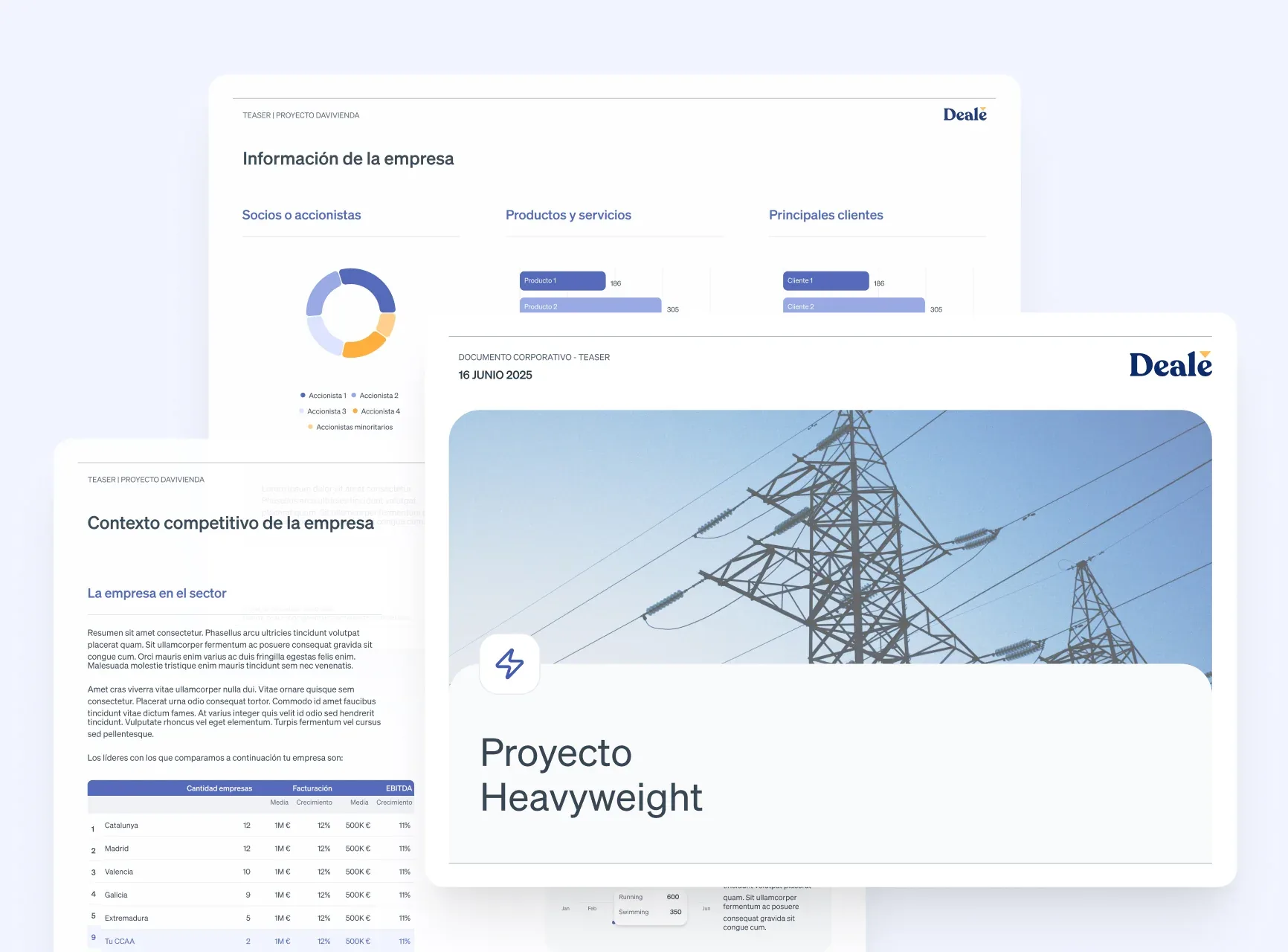
The teaser is one of the most important documents in a business sale process (M&A). It's the first impression a potential investor or buyer gets of your company, and whether the process moves forward or stalls at the first stage depends largely on its quality.
In this guide, we explain exactly what a teaser is, what information it should include, how it's distributed, the most common mistakes when preparing one, and why it's key to finding the right investor. At the end of the post, you can download a real example of an M&A teaser.
What a business teaser is
A teaser — also known as a blind profile or anonymous profile — is a short document (usually 1–3 pages) that presents a company anonymously to potential investors or buyers. Its goal is to spark interest without revealing the company's identity, thereby protecting the seller's confidentiality.
It's the first introduction an investor receives when an opportunity is put to them. If the teaser is attractive and well built, the investor will ask to sign a non-disclosure agreement (NDA) to access more detailed information. If it isn't, the opportunity will simply be discarded.
Why the teaser is key in an M&A deal
Investors — whether private equity firms, strategic buyers, or family offices — receive dozens of opportunities every month. Their time is limited, and they need to quickly filter which companies deserve in-depth analysis and which don't.
The teaser is that initial filter. In 1–3 pages, it must answer three questions:
- What does the company do? Business model, sector, target customers.
- Why is it worth investing in? Growth, profitability, competitive advantage.
- What exactly is being offered? Deal type (full sale, partial sale, growth capital) and valuation range.
If these three questions aren't clear within the first 30 seconds of reading, the investor will move on to the next teaser. That's why clarity and concision matter more than length or detail.
What information a teaser should include
Although each teaser is tailored to the deal, the typical sections are:
- Executive summary: a 2–3 line description of the business and the investment opportunity.
- Sector and business model: the market it operates in, value proposition, products or services.
- Key financial figures: revenue, EBITDA, and growth over the last 3 years.
- Customers and market: main customers (anonymized), diversification, geographies.
- Team: structure of the management team and workforce, without specific names.
- Reason for the deal: why the company is being sold and what is on offer (capital, control, full sale).
- Contact information: the advisor or intermediary managing the deal.
The key is to anonymize the company: its name, exact location, or any data that could identify it should never appear. The sector is described generically (“B2B services company in the industrial sector”) and customers only by type (“3 IBEX-listed multinationals, multi-year contracts”).
Need to create a professional teaser for your business? With Deale, you'll get one automatically when you sign up as a seller, in less than 30 minutes.
Sign up now
How a teaser is distributed and who it reaches
Traditionally, teasers are distributed through M&A advisors who have a network of contacts — funds, family offices, strategic buyers — to whom they send opportunities manually and selectively. This method has two limitations: limited reach and a lot of time spent on each mailing.
Digital M&A platforms have transformed this process. They allow a well-prepared teaser to reach, confidentially and selectively, hundreds or thousands of qualified investors who have previously shown interest in deals with a specific profile. This multiplies the chances of finding the right buyer or investor in less time.
Once the teaser sparks an investor's interest, the Q&A stage begins, in which more detailed information is exchanged under NDA, followed by negotiations that can lead to a letter of intent (LOI).
The most common mistakes when preparing a teaser
These are the mistakes that most undermine a teaser's effectiveness:
- Too much information: a 10-page teaser isn't a teaser; it's an information memorandum (IM), which is the next stage after signing the NDA.
- No concrete figures: if revenue, EBITDA, and growth aren't included, the investor can't assess whether the opportunity fits their thesis.
- Breaching confidentiality: including the company's name, identifiable data, or too many sector details can compromise the seller.
- Not explaining the opportunity: presenting only the company without explaining what's on offer (percentage, valuation, deal type) leaves the investor with no context to decide.
- Sloppy design: a poorly laid-out teaser comes across as unprofessional and lowers the perceived value of the company.
Frequently asked questions about the teaser
What's the difference between a teaser and an information memorandum?
The teaser is the initial anonymous presentation (1–3 pages) that sparks interest. The information memorandum (IM), or offering memorandum, is the detailed document (20–50 pages) the investor receives after signing the NDA, with complete information about the company, its accounts, customers, team, and projections.
Who prepares the teaser?
It's usually prepared by the M&A advisor working with the seller, together with the company's management team. On digital platforms like Deale, the teaser is generated automatically from the information the seller enters in their profile, cutting preparation time from weeks to hours.
How long does it take to prepare a teaser?
Done manually, between 2 and 4 weeks from the start of the process, depending on the company's complexity and the availability of financial information. With digital tools, this time can be cut to days or even hours.
Is a teaser required to sell a business?
It isn't legally required, but it's highly recommended. Without a well-prepared teaser, the seller depends on word of mouth and the advisor's network of contacts, which drastically reduces the chances of finding the ideal buyer and getting the best valuation.
A real example of an M&A teaser
To give you a concrete idea of how a professional teaser is built, here's a real example prepared by Deale. In it, you'll see how the information is structured, what level of detail is appropriate, and how confidentiality is maintained while conveying the company's full potential.

